Built for ServiceNow estates · read-only by design
Diagrams That Stay True to the CMDB — and Generate the Change Package
Stop redrawing what the CMDB already knows. ArchTruth generates the diagram from the records, you design what comes next as a layer over what exists, and the change request package and decision record fall out of the diff. Your coding agents keep all of it current — your instance stays read-only.
- No credit card
- Never writes to your instance
- Everything exports as plain text
< 15 s
from CMDB scope to a bound diagram
0
writes to your ServiceNow instance
100 %
of generated nodes carry a record id
412
what an agent gets when it edits stale — never a clobber
01 · Product
Diagrams Nobody Has to Redraw
DSL as the Source of Truth
A line-oriented grammar for nodes, groups, edges, rules and layers. Diff-able, reviewable, agent-editable.
Bound to the CMDB
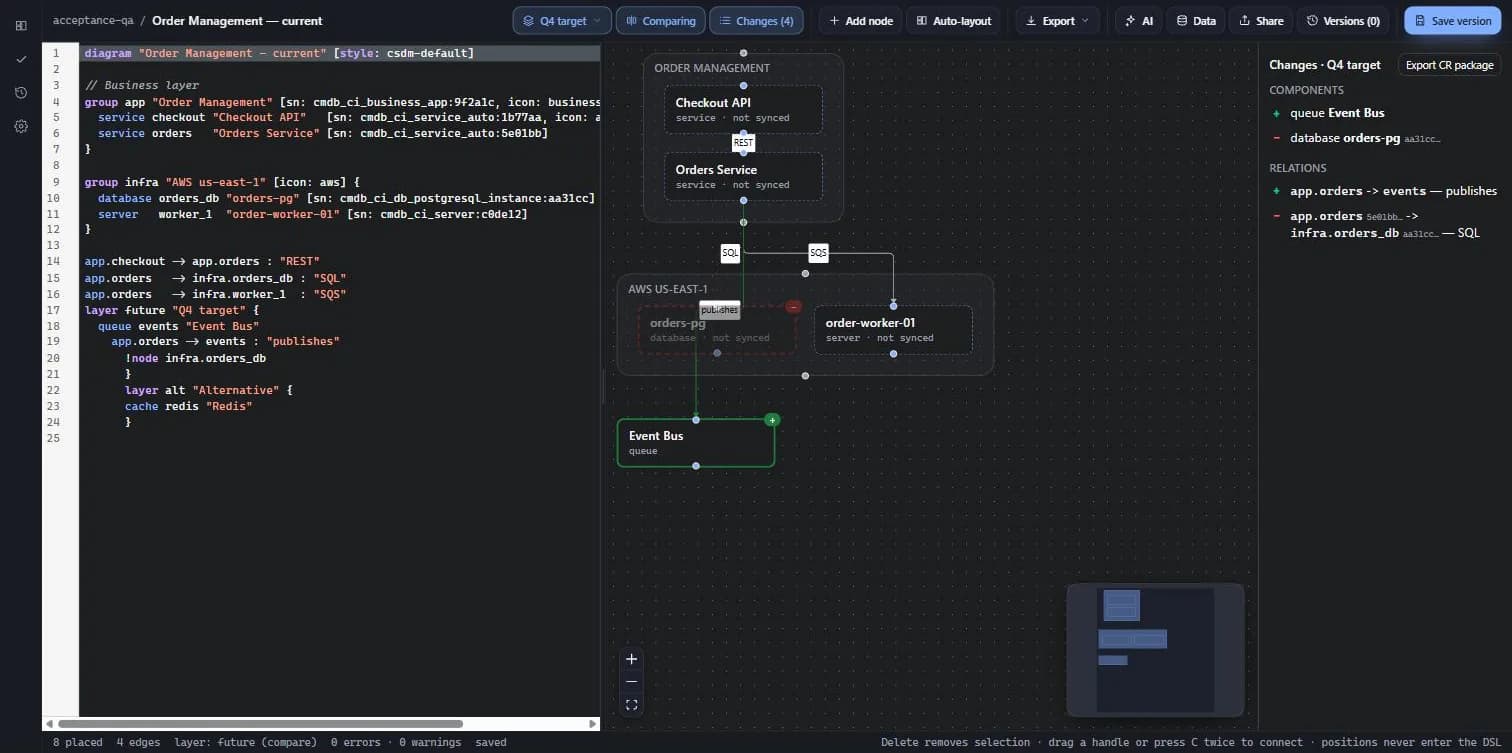
Every node carries sn: <class>:<sys_id>. Refresh shows what moved; rules paint criticality, environment, ownership.
Future-State Layers
Design to-be over as-is, compare with ghosted removals, export the change request package.
Decision Records
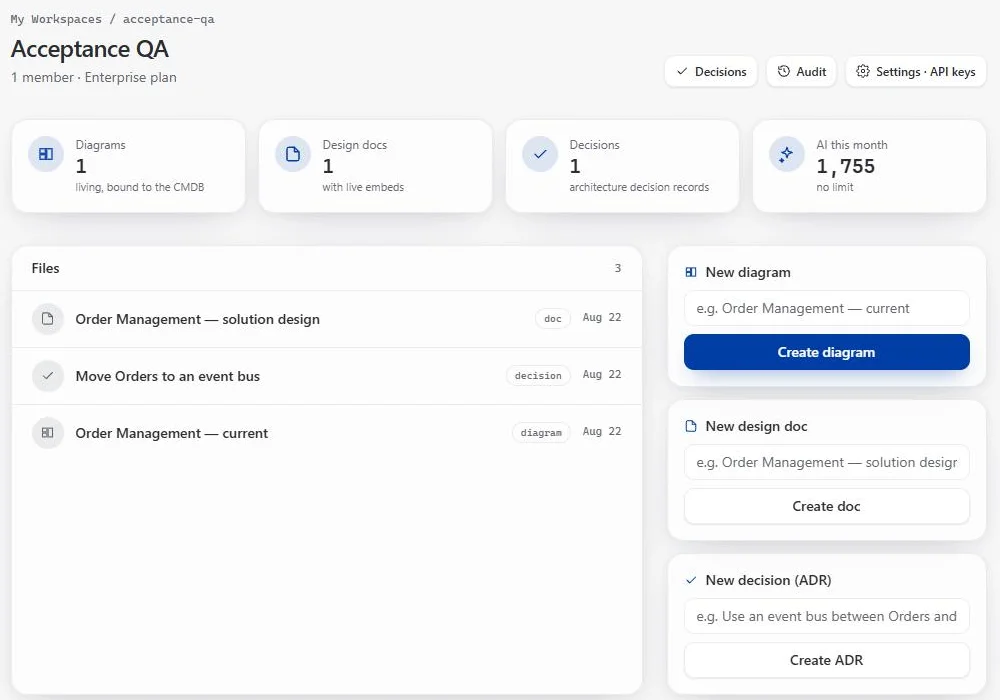
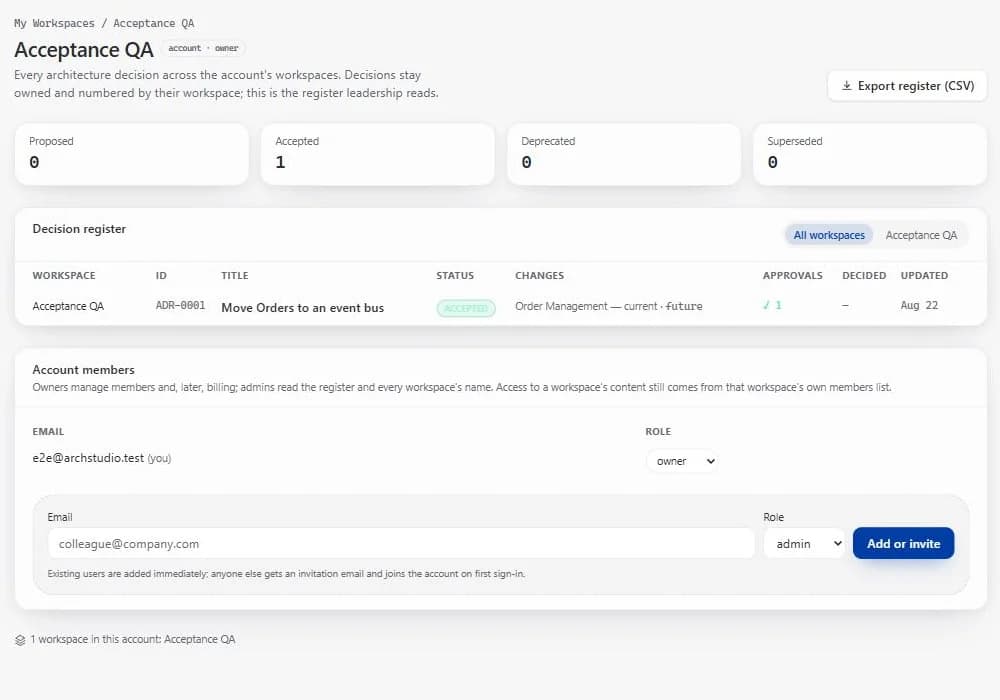
Numbered ADRs with status, supersedes, approvals and an AI draft from the change set. Cited in the CR.
REST + MCP
OpenAPI 3.1 and an MCP server expose list, get, patch, render, search. Same handlers the editor uses.
Built for the Auditor
Immutable versions, append-only audit log, expiring view-only share links. Name the record behind any node.
02 · How It Works
From CMDB Scope to Approved Change
01Step
Connect and Pick a Scope
OAuth to your instance, read-only. Search a business application or service; we walk cmdb_rel_ci to the depth you choose.
- PKCE OAuth, tokens in a vault
- Depth-bounded traversal
- CSDM family grouping
02Step
Edit as Canvas or Code
The diagram is a readable DSL. Drag on the canvas or type — both edit the same text, and untouched lines never change.
- Byte-stable comments and order
- AI generate and AI edit
- Conditional formatting from CMDB fields
03Step
Design the Future as a Layer
Add, remove, rewire on a layer over the current state. Compare shows exactly what moved, with the sys_ids behind it.
- Change set with CI references
- CR package: before, after, changes, description
- ADRs tied to the layer
04Step
Let Agents Keep It Current
Claude Code and CI call the same typed edits through REST and MCP, with If-Match safety and an attributed audit trail.
- Org-scoped API keys
- 8 MCP tools
- Every write attributed
03 · Agents
Your Coding Agent Maintains the Diagram
Plenty of tools speak MCP now; almost none make the write safe. Connect Claude Code with one line — it reads the DSL, proposes typed edits, and commits with If-Match, so a stale revision gets a 412 instead of silently overwriting an architect's work. Every write lands as a version attributed to the key.
list_diagrams · get_diagram · search_diagramspatch_diagram with typed ops (add, remove, set, move, layer)render_diagram as SVG · validate_dsl before saving
$ claude mcp add --transport http archtruth \
    https://archtruth.app/api/mcp \
    --header "Authorization: Bearer as_live_…"

> add a cache service called Redis between
  Orders and the orders DB in "Order Management — current"

  get_diagram    revision 7
  patch_diagram  addNode cache redis "Redis"
                 addEdge app.orders -> infra.redis
  ✓ revision 8 · version 12 · attributed to key claude-code
04 · Why ArchTruth
You Already Have Dependency Views. This Is Different.
Dependency Views and EA Workspace are good at showing what the CMDB knows — inside the platform. Diagram tools are good at drawing — disconnected from it. ArchTruth is built for the work that happens around a change: a diffable source of truth your agents can edit safely, and a CR package and decision record that write themselves from the diff.
| Capability | Native views & EA Workspace | ServiceNow-native modelling apps | Visio · Lucid · draw.io | ArchTruth |
|---|---|---|---|---|
| Reflects live CMDB records | Inside the platform | Yes — built on CSDM | Manual copy, drifts by week two | Every node carries the sys_id; refresh shows what moved |
| Diagram is diffable plain text | — | Not advertised | Proprietary or XML formats | A readable DSL — reviewable in Git, versioned, byte-stable |
| Agents edit it safely | — | Not advertised | MCP, but no concurrency control | Typed ops with If-Match; a stale write gets a 412, never a clobber |
| Future state produces the CR | Partial, in-platform | Future state, then commit back | Screenshot into a Word doc | The layer diff exports the CR package with the CIs behind it |
| Decisions cite the change | Native ADRs, separate from the diff | Versioned diagrams | Separate artifacts | Numbered ADRs linked to the layer, cited in the CR |
| Never writes to your instance | n/a — is ServiceNow | Writes back on approval | n/a — disconnected | No non-GET call exists in the codebase |
Keep your native views — ArchTruth reads the same records and never writes back. Use it where they stop: the change package, artifacts your team can review in Git, and agents that edit without clobbering. Established ServiceNow-native modelling apps (ins-pi and others) do current- and future-state design well and have done since 2015; the columns above reflect what their public listings advertise, not a claim about what their products can do. Compare them properly — we would rather lose a deal than win one on a misleading table.
See Your Own CMDB as a Living Diagram
Thirty minutes with a PDI or sandbox is all it takes. Leave with a diagram you can defend.